


Free Shipping All Orders Over $95
The FDA received more than 300 adverse-event reports involving children and adults who consumed delta-8 THC products from January 2021 through December 2023, and approximately two-thirds involved foods such as candy or brownies, according to its warning letter to Life Leaf Medical CBD Center. That reframes the question about THC Nerds Rope. Before asking how strong it is, ask whether you can verify what's inside and measure a serving.
THC Nerds Rope isn't a standardized dose or a guarantee of authenticity. The name describes products sold in a recognizable candy-like format. For an adult buyer, the important distinctions are the cannabinoid, the batch documentation, the serving boundaries, and the seller's legal status.
A THC Nerds Rope has no standard dose. A package's total THC tells you how much it claims to contain, not how much you should consume. Without a verified serving size, a potency tier is only a guess.
The table below is a decision guide, not a set of universally safe milligram ranges. A numerical recommendation needs reliable product information and individual context, including previous edible experience and medications.
| Dose tier | THC per serving | Who it suits | Wait before redosing |
|---|---|---|---|
| Starter | Lowest clearly measured, verified serving selected with appropriate guidance | First-time or infrequent users should prefer a simpler, individually portioned product | Complete the labeled waiting period and reassess |
| Low | A verified serving below the amount previously tolerated | Occasional users with relevant edible experience | Complete the labeled waiting period; don't add more while effects are developing |
| Moderate | A verified serving assessed against personal tolerance | Regular users who know their response to oral THC | Wait until the response is clear; skipping another dose is reasonable |
| High | A serving identified as high potency on verified documentation | Not an appropriate starting point; experience doesn't remove risk | Don't treat elapsed time alone as permission to take more |
A beginner shouldn't choose a rope because it looks easy to nibble. Choose a product with a small, discrete serving that doesn't require estimating where to cut. A serving is a measurement, not a recommendation to consume the entire amount.
Tolerance also needs context. Being comfortable with inhaled cannabis doesn't establish that you'll respond predictably to an edible. Nor does a familiar flavor tell you anything about cannabinoid concentration.
Practical rule: If you can't identify a measured serving before opening the package, don't use the package total to improvise one.
For a fuller explanation of portioning and cautious decision-making, use this guide to dosing edibles.
Start by finding the declared total THC and the number of servings. Divide the total by the serving count, then compare that result with the stated amount per serving. That arithmetic checks the label's consistency. It does not establish that the manufacturer distributed THC evenly or that the label matches the contents.
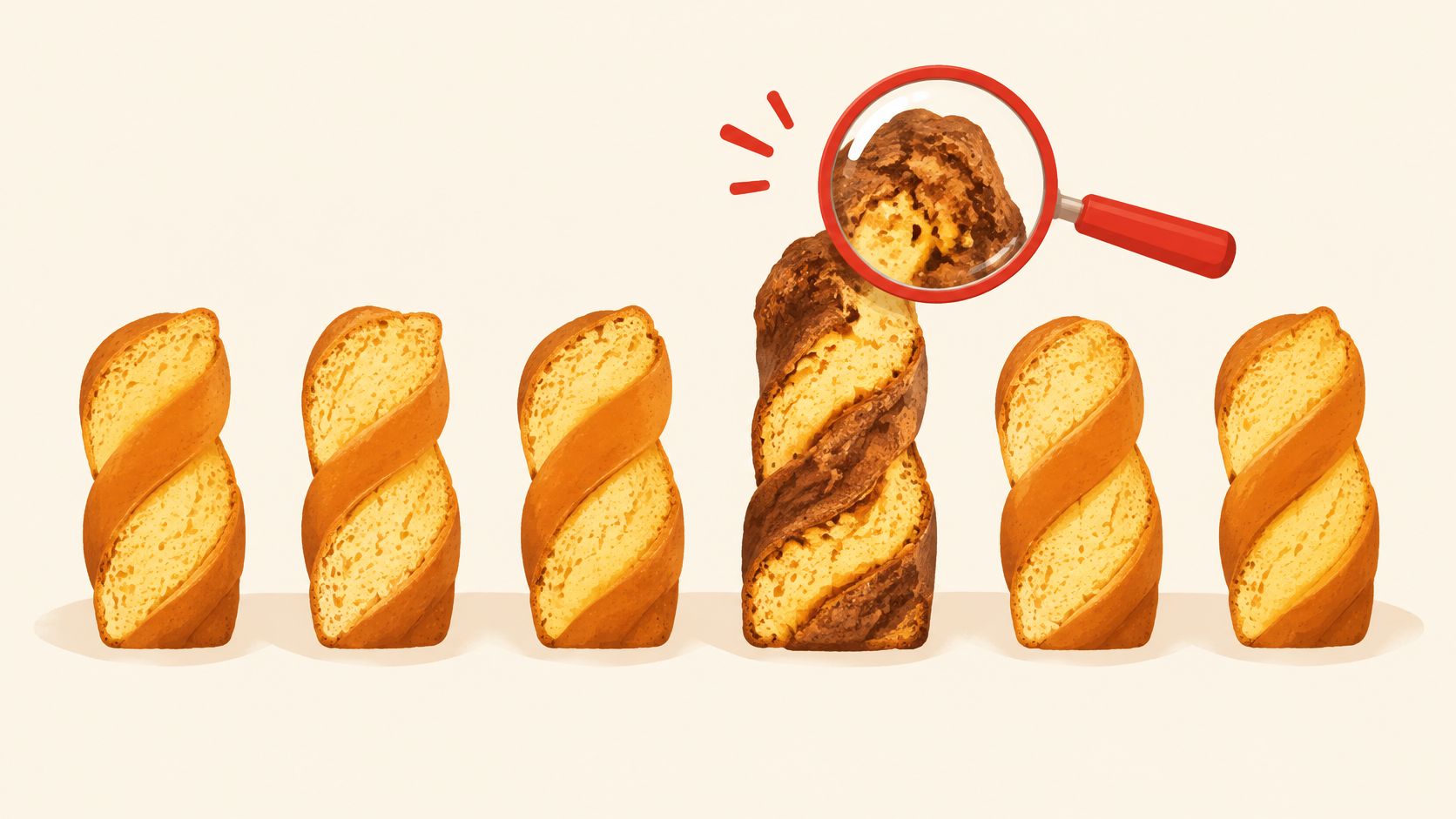
A rope is like a loaf cake sliced into strips. If the baker didn't mix the batter properly, equal-looking slices may contain different amounts of an ingredient. Cutting them more neatly won't fix the mixture.
With an infused rope, you can see the candy coating and the length of each segment. You can't see the cannabinoid distribution. A shorter piece isn't automatically a known dose.
This inspection image illustrates the difference between noticing appearance and verifying composition.
In a controlled crossover study published in the Journal of Analytical Toxicology, 17 infrequent cannabis users received brownies containing 10, 25, and 50 mg of delta-9 THC across repeated sessions. Those amounts describe study conditions. They aren't beginner recommendations or standardized rope servings.
Oral THC passes through the digestive system and undergoes first-pass metabolism in the liver. Exposure is delayed and highly variable, and blood THC doesn't reliably indicate perceived intensity or impairment. A laboratory measurement from someone's bloodstream therefore isn't a simple strength meter for their experience.
The practical problem is that a person can finish eating before understanding the effect. They may assume the product isn't working and take another segment. When the delayed effects develop, they've already committed to the additional amount.
Dose uniformity means that the intended portions contain consistent amounts of cannabinoid. It's a manufacturing and testing issue, not something a buyer can establish with scissors or a kitchen scale.
A manufacturer should define the portions during production and explain how each portion relates to the tested product. An unmarked continuous strip leaves too much work to the consumer, especially when thickness or coating changes along its length.
A measured piece is a useful dose unit only when its cannabinoid content is supported by the product's manufacturing controls.
The working rule is a defined portion with verified content, not a bite judged by appearance. If the manufacturer can't connect the serving instruction to the tested batch, cutting the rope doesn't resolve the uncertainty.
The word THC on a rope package isn't specific enough. Hemp-derived delta-9, delta-8, THCA, and marijuana-derived THC aren't interchangeable descriptions. They raise different questions about cannabinoid identity, processing, intoxication, and lawful sale.
Start with the full ingredient and cannabinoid names. A large THC claim on the front of the bag doesn't tell you which compound accounts for that total. A hemp statement doesn't establish that the finished edible is lawful where you live.
Use this comparison to decide what information to request. It isn't a nationwide legal clearance.
| THC type | Source | Intoxicating | Legal pattern | Red flag |
|---|---|---|---|---|
| Hemp-derived delta-9 THC | Cannabis represented as hemp | Yes | Hemp classification and finished-food legality require separate checks | Seller offers a hemp claim but no batch COA |
| Delta-8 THC | Ask the manufacturer to identify the starting material and processing | Yes | Specific edible products have faced FDA and FTC action | Packaging copies recognizable candy branding |
| THCA | Acid-form cannabinoid found in cannabis | Not equivalent to active delta-9; heating changes its form | Product form and jurisdiction matter | Seller treats THCA and delta-9 as interchangeable |
| Marijuana-derived THC | Cannabis supplied through a regulated cannabis market | Yes | Check the applicable licensed sales channel | A purported regulated product has no verifiable license |
A seller should be able to explain both what the cannabinoid is and why that particular product can be sold to you. Those are different questions. A certificate can help establish composition, but it doesn't grant permission to sell or ship.
Check the relevant regulator's current requirements for possession, purchase, product type, and shipping destination. This state cannabis laws guide can help organize that review, but a seller's availability map isn't a substitute for applicable law.
The conventional Nerds Rope debuted in 2001, according to NBC Select's account of the candy's history. THC versions adopted a recognizable confectionery format; that doesn't establish a relationship with the original candy manufacturer.
The regulatory concern is more concrete than an unusual name. In 2023, the FTC's joint enforcement announcement with the FDA identified a product marketed as Rope 500mg Delta-8 Nerds Candy among products targeted for deceptive, candy-like presentation. That package claim was a product name, not independent verification of potency.
The FDA warning letter to Haunted Vapor Room also illustrates why imitation packaging and delta-8 food ingredients require scrutiny. Findings about specific products shouldn't be stretched into a claim that every hemp edible or rope-shaped product has the same regulatory status.
Before considering flavor, inspect the package:
A polished counterfeit can still have a scannable code. Conversely, an unfamiliar brand isn't automatically counterfeit. Authenticity comes from verifiable identity and traceability, not visual confidence.
A certificate of analysis, or COA, reports laboratory findings for a sample. It helps only when that sample can be matched to the product in your hand. A generic report on a shop page cannot confirm what is inside an unrelated package.
Edible potency can differ meaningfully from the amount stated on the label. Start with a small, measured amount and follow the product's labeled waiting period before deciding whether to take more. A rope is hard to dose by eye, so don't treat its length or appearance as a measure of potency.
Use the checklist as a prompt, then inspect the report itself.
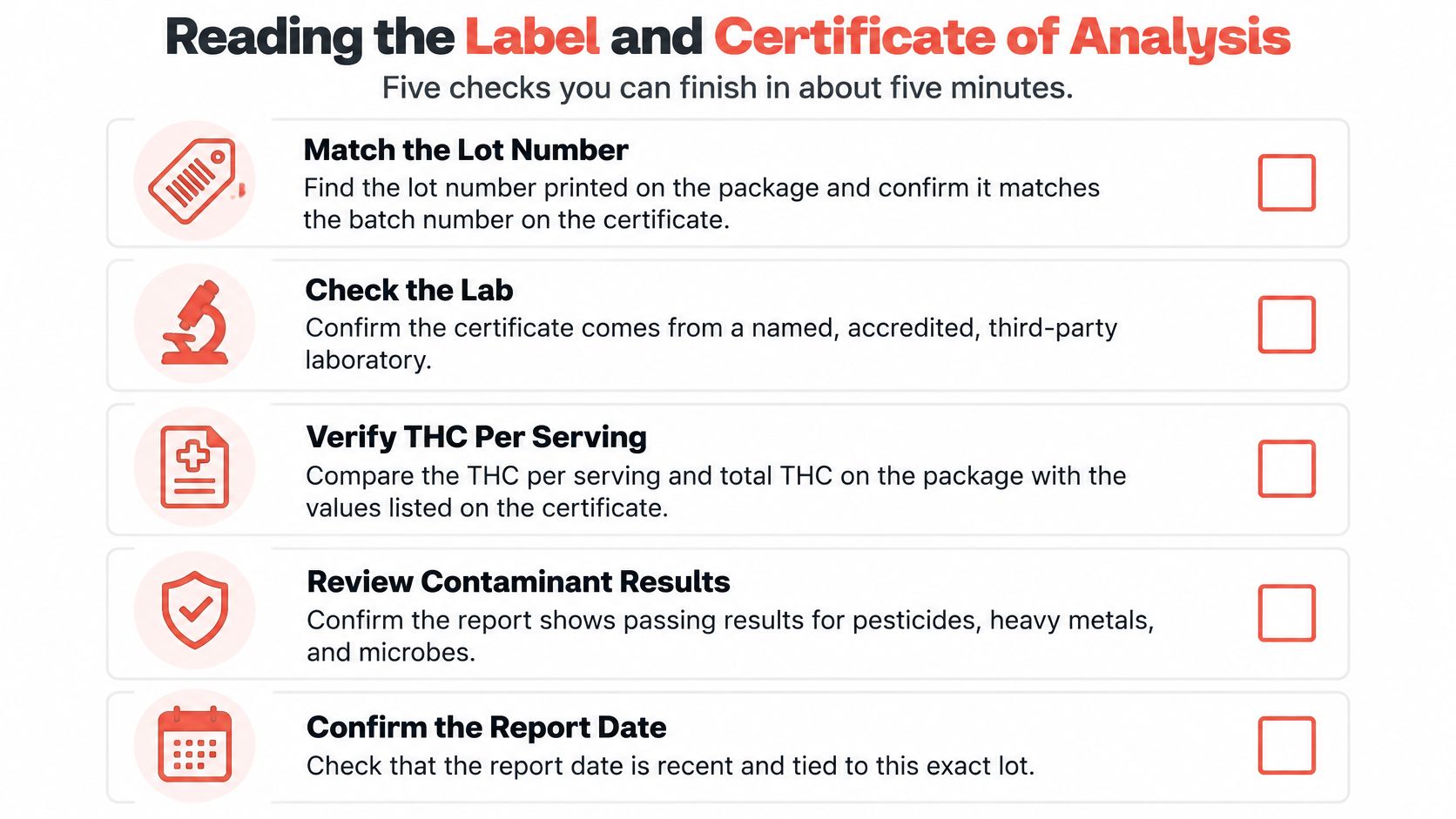
Look for per-serving and total-package potency, with compatible units. Multiply the declared potency per serving by the number of servings. If the result does not match the package total, ask the manufacturer to explain before relying on either figure.
Check whether the report covers pesticides, heavy metals, residual solvents, and microbes. A potency result alone does not show that these other categories were assessed.
Ask how the producer checks whether the rope is uniform throughout. A batch result does not prove that each cut segment contains the same amount. A stated tolerance or measurement uncertainty can clarify the limits of the result.
For help interpreting report fields, use this guide to reading a certificate of analysis.
Treat unexplained mismatches, an unnamed laboratory, or an undated report as unresolved verification failures. Don't use the package's headline milligrams as a substitute for missing documentation.
The safest response to an unverified rope is not to eat it. The steps below apply only after an adult has established that the product is appropriate, legally available, and supported by usable serving instructions.
Use the process graphic as a reminder to make decisions before consumption.
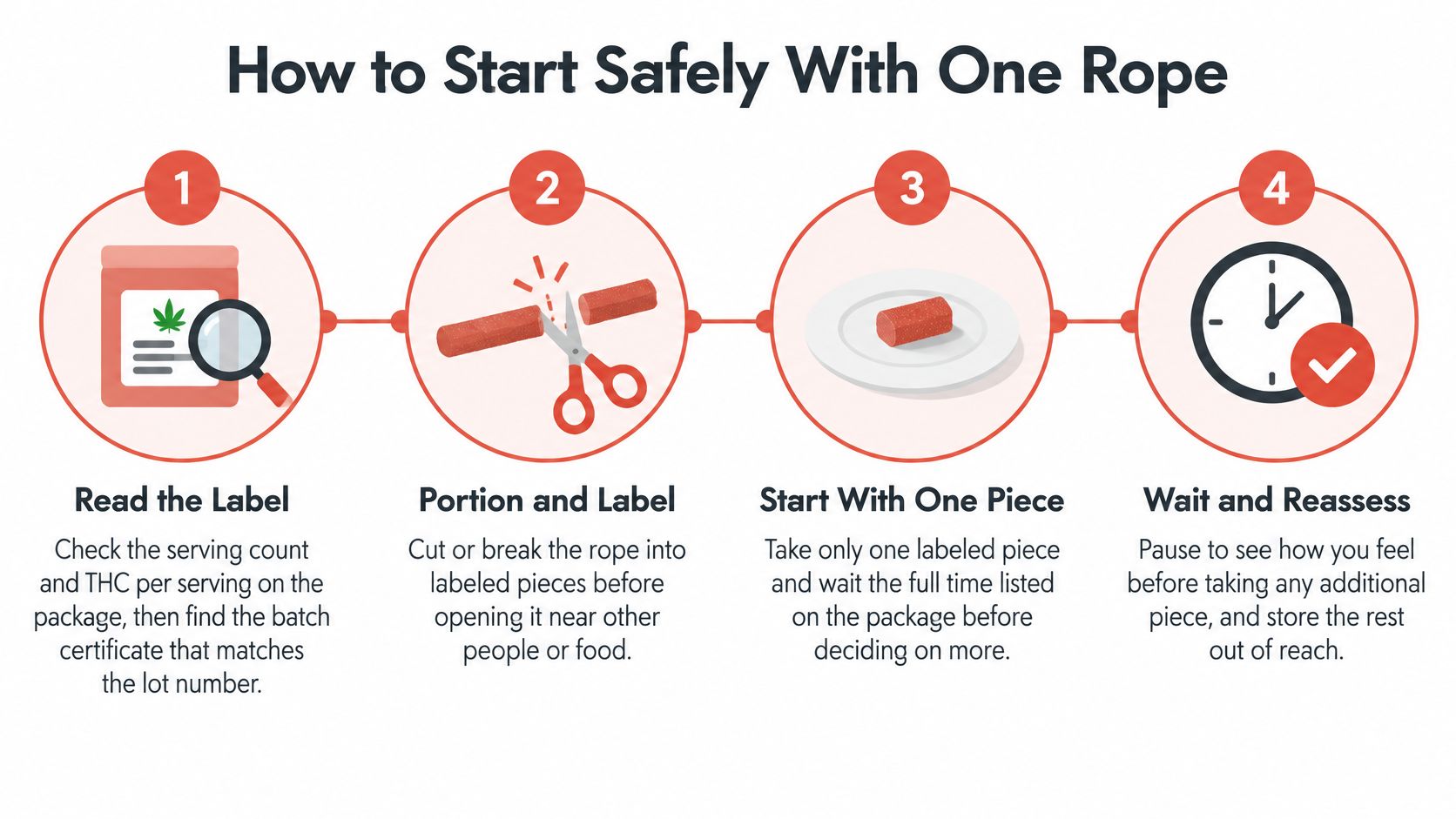
The common slip is opening the rope and nibbling a strip to test it. That bypasses portion control and makes it harder to reconstruct how much was eaten.
This video provides an additional viewing resource alongside the written precautions.
The distinction is between a defined portion and an improvised portion. A package with individually specified pieces gives you a usable serving instruction when its documentation supports it. A continuous rope with no piece count, validated cut length, or uniformity evidence doesn't become reliably portioned through careful guessing.
Keep a THC rope in its original, clearly labeled, child-resistant packaging, locked away from ordinary candy, snacks, and pet food. Follow the package's storage conditions and keep it in a cool, dry location away from direct light. Child-resistant doesn't mean childproof, and a high shelf isn't locked storage.
The FDA's warning about accidental ingestion of THC-containing foods described effects including hallucinations, increased heart rate, vomiting, medical intervention, and hospital admission. It reported ten cases involving copycat products resembling familiar foods, including Nerds Rope. The practical concern is mistaken identity, not an adult just choosing a stronger edible.
If someone may have eaten an unknown amount, save the packaging and note the estimated amount and time. Don't wait for symptoms before seeking advice, particularly when a child is involved.
| Situation | What to do now | Who to contact |
|---|---|---|
| Child ate an unknown amount | Keep the packaging, note the time and estimated amount, and don't wait for symptoms | U.S. Poison Control at 1-800-222-1222 right away |
| Adult ate too much, mild symptoms | Stop consumption, rest somewhere quiet, don't drive, and have a sober person stay nearby | Poison Control for advice |
| Racing heart, vomiting, or confusion | Stay with the person and describe the symptoms accurately | Poison Control promptly, or emergency services if symptoms are severe |
| Trouble breathing, seizure, or unresponsive | Call emergency services immediately and follow the dispatcher's instructions | 911 in the United States |
For an unresponsive person who is breathing normally, place them on their side if you can do so safely. If they aren't breathing normally, follow the dispatcher's resuscitation instructions. Don't give food or water to someone who isn't fully alert, and don't induce vomiting.
Household safeguard: Tell other adults where the product is locked and keep its identification available. An emergency is the wrong time to discover nobody knows what was eaten.
Pet exposure requires veterinary advice. Contact a veterinarian or animal poison service rather than applying human dosing assumptions.
For someone new to edibles, a rope is usually an unnecessarily complicated starting format. A clearly labeled, individually portioned product is easier to evaluate and manage. There's no benefit in adding uncertain cutting and candy-like presentation to an unfamiliar response.
An experienced adult should still judge the product on documentation and suitability, not confidence. Familiarity with cannabis can help someone recognize their response, but it can't authenticate a batch or repair inconsistent manufacturing.
| Buyer situation | Verdict | Condition before using |
|---|---|---|
| New to THC edibles | Skip rope-shaped products | Choose a verified, clearly portioned alternative with appropriate low-dose guidance |
| Household with children or pets | Prefer not to keep THC rope at home | If already owned, maintain locked storage out of reach |
| Taking medication, pregnant, or driving that day | Don't use pending an appropriate decision | Seek clinician advice for medication concerns; avoid cannabis during pregnancy and don't combine use with driving |
| Experienced adult buying from a licensed seller | Consider with caution | The batch certificate matches the lot, the math reconciles, and portions are supported |
A household storage plan must work during ordinary routines, not just immediately after purchase. Consider visitors, shared kitchens, caregivers, and anyone who could mistake the package for food. If you can't maintain secure separation, don't bring the rope home.
Medication questions belong with a clinician or pharmacist who knows what you take. Don't treat a seller's reassurance as a review of your medical situation. Pregnancy and driving also aren't situations where a reassuring package can remove the concern.
For an experienced buyer, the strongest reasons to walk away are straightforward:
Decide before opening the package. Pull the batch certificate, compare the declared serving with the supported portion, and choose whether the uncertainty is acceptable. If a basic check fails, leaving the product unopened is a successful decision.
Melt offers hemp-derived cannabinoid products, third-party lab reporting, and educational guides to help adults evaluate what they're buying. Visit Melt to review product information and available lab reports, then check cannabinoid identity, serving instructions, and local eligibility before choosing an edible.
Your cart is currently empty.